
Jack polynomials and free cumulants
Page of Michel Lassalle
List of publications
Some preprints
Tables for
characters of the
symmetric group
Symmetric functions
and
Jucys-Murphy elements
Tables for
Jack polynomials :
Jack polynomials
and alpha-contents
A conjecture for
Jack polynomials
This page gives new data for Jack polynomials. Our results have been published there.
Being given some parameter &alpha and an arbitrary partition &lambda, we consider the Jack polynomial associated to &lambda, and its development in terms of the power sum symmetric functions, i.e. we write
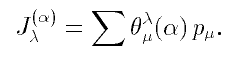
For &mu with no part 1 and weight k, we give the explicit expression of the coefficients
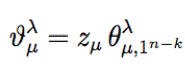
in terms of the free cumulants of the anisotropic diagram of &lambda.
These coefficients are known to be polynomials in the free cumulants. We list themOur data support the following conjectures :
- for any partition &mu, with weight(&mu) - length(&mu) < 9,
- when &mu is a hook (r,1,...,1), for r from 2 to 20,
- when &mu=(r,s) has length 2, for r+s from 4 to 18.
These conjectures extend the Kerov-Biane ex-conjecture for characters of the symmetric group, recently proved by Feray.
- These coefficients are polynomials in &alpha and &beta = 1- &alpha, with integer coefficients.
- When &mu is a hook, their integer coefficients are nonnegative.
- When &mu is not a hook, their integer coefficients may be negative but an appropriately modified polynomial has still nonnegative coefficients.
Tables giving &theta (&lambda,&mu) When &mu is not a hook, tables giving the modified &theta (&lambda,&mu) for partitions &mu=(r,s) with r+s from 4 to 18
(0.5 Mo).Tables for bigger values may be given upon request.
For &alpha = 1 ( i.e. a = 1 and b = 0 ), these tables give the Kerov-Biane polynomials , expressing the normalized characters of the symmetric group.
Our results are in Maple format. They should be read as follows.Example :
- The parameter &alpha is denoted by the letter a, and the letter b stands for &beta = 1-&alpha.
- The partition &lambda is kept arbitrary.
The notation R_k stands for the k-th free cumulant of the anisotropic diagram of &lambda.
- &mu denotes a partition without any part 1.
- Each table gives first the partition &mu, then
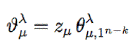
[2]
a*b*R2+a^2*R3
[3]
2*a*b^2*R2+a^2*R2+3*a^2*b*R3+a^3*R4
means

Last modified : February 4, 2008
Back to top